All Death at Fleming Manor guides
Episode 4, A Breathless Death, follows the painter Elenor Ainsworth’s last minutes and the emergency procedure in her bedroom. The doctor’s witness statement, especially matching her room to the floor map, is where most players stall.
Episode 4: A Breathless Death Walkthrough
In this episode, you don’t move between scenes by clicking. Use the button in the lower right corner instead.
Words
Scene 1: Bedroom
Take note of the old woman’s cyanotic fingertips.
- Newspaper: Cigarette Holder, Hot Tea, Teaspoon
- Doctor: Penlight, Pocket Knife
- Nurse:
- Dialogue: Hampton
- Inventory: Bandage, Thermometer
- How To Survive 3rd Floor: Violet, Nurse, Margaret, Pembroke, Lavinia, Templeton, Elenor, Ainsworth, Artist
- Nursing Notes: Aspirin, Gipson, Morphine, Morris, Green, Tafenol, Jones
- Dog Food Bowl: Chester
- Syringe: Syringe
- Palette Knife: Palette Knife
- Corkscrew: Corkscrew
- Shot Glass: Stirring Rod
- Brandy: Brandy
Scene 2: Hallway
- Lady: Barker
- Fallen Man: Playing Cards, Wilfred, Stanley, Keys
Scene 3: Medical Book
Hypovolemic, Cardiogenic, Distributive, Obstructive, Asphyxia, Suffocation, Strangulation, Smothering, Choking, Hanging, Ligature, Manual, Anaphylaxis, Epinephrine, Tracheostomy, Thyroid, Cricoid, Tracheal, Cricothyrotomy
Form 1: Names
- The latest nursing notes have no signature because the shift was cut short. Find another way to identify the nurse on duty.
- You can work it out from the clues, but the briefing already said you are here for the death of Elenor Ainsworth. She is the woman in critical condition.
- Each nurse has very recognizable handwriting.
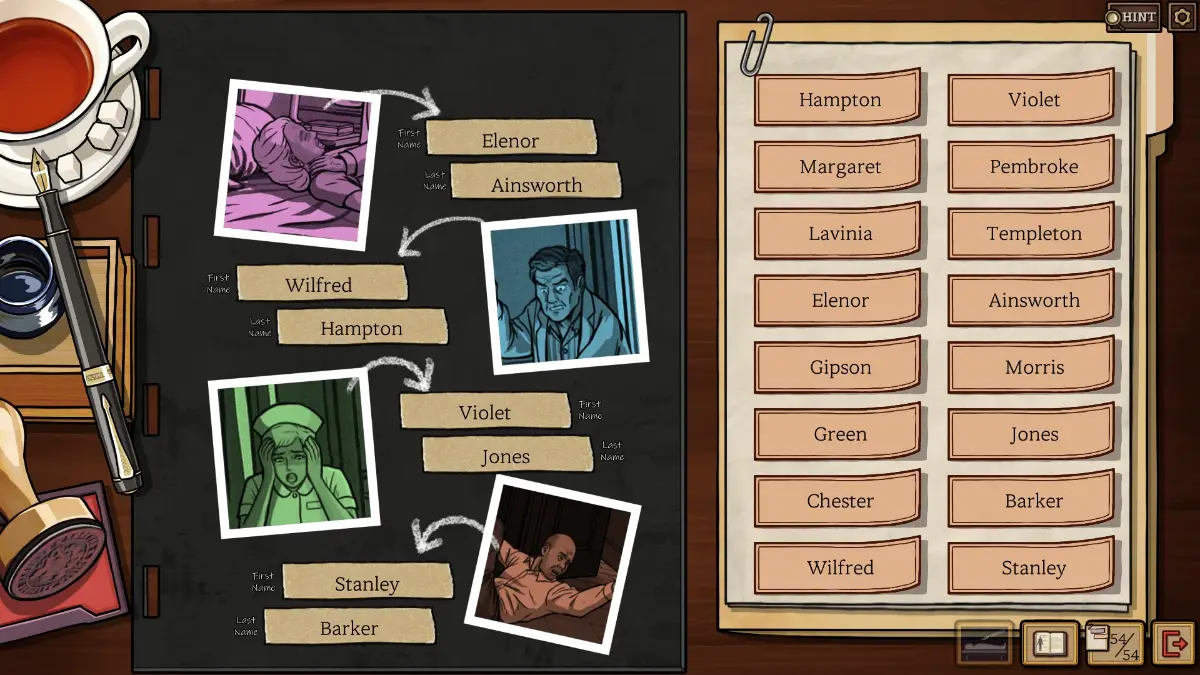
Witness Statements
- The next forms are the witness statements from the doctor and the nurse.
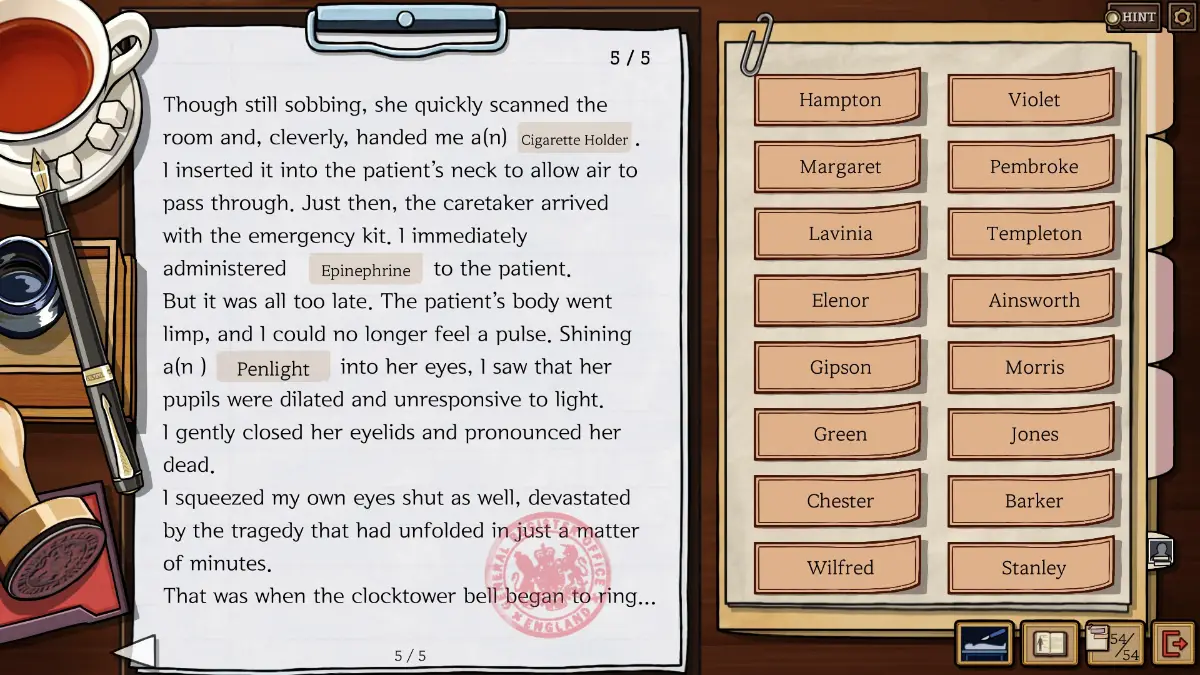
- The scene shows the moment before the doctor cut into her throat. Some things, like the tube-shaped object being inserted, have not happened yet.
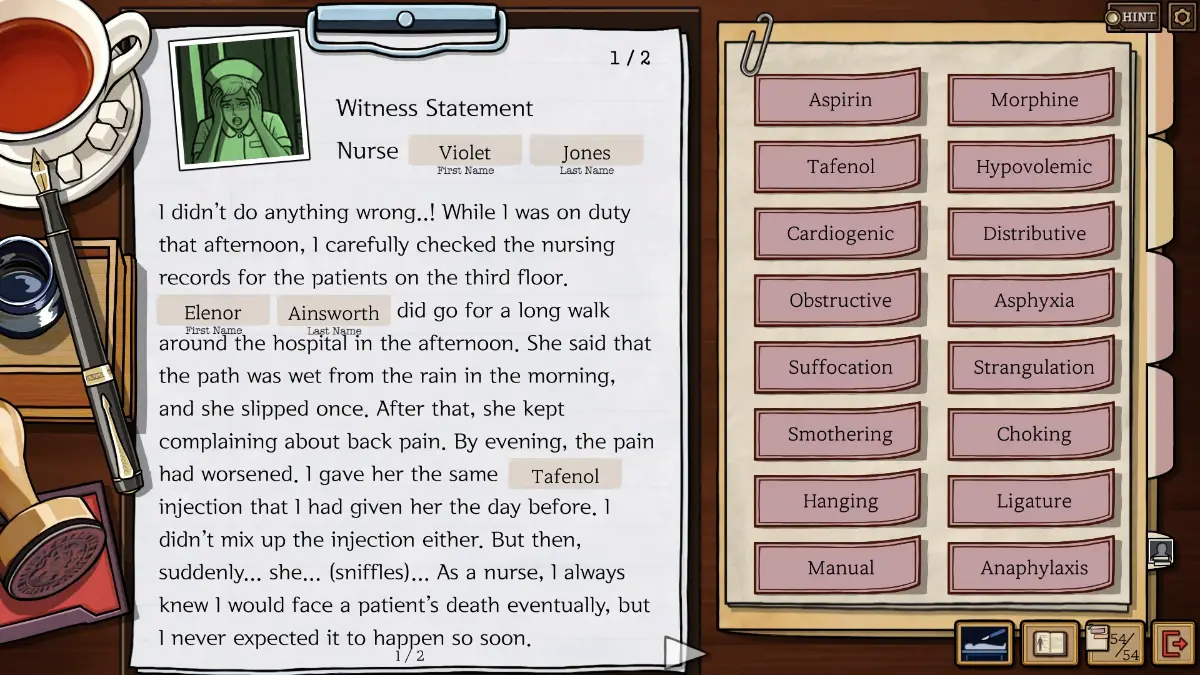
- The nurse’s statement only tests careful reading. You already know everyone’s names, and the medicine and the dog are easy to find.
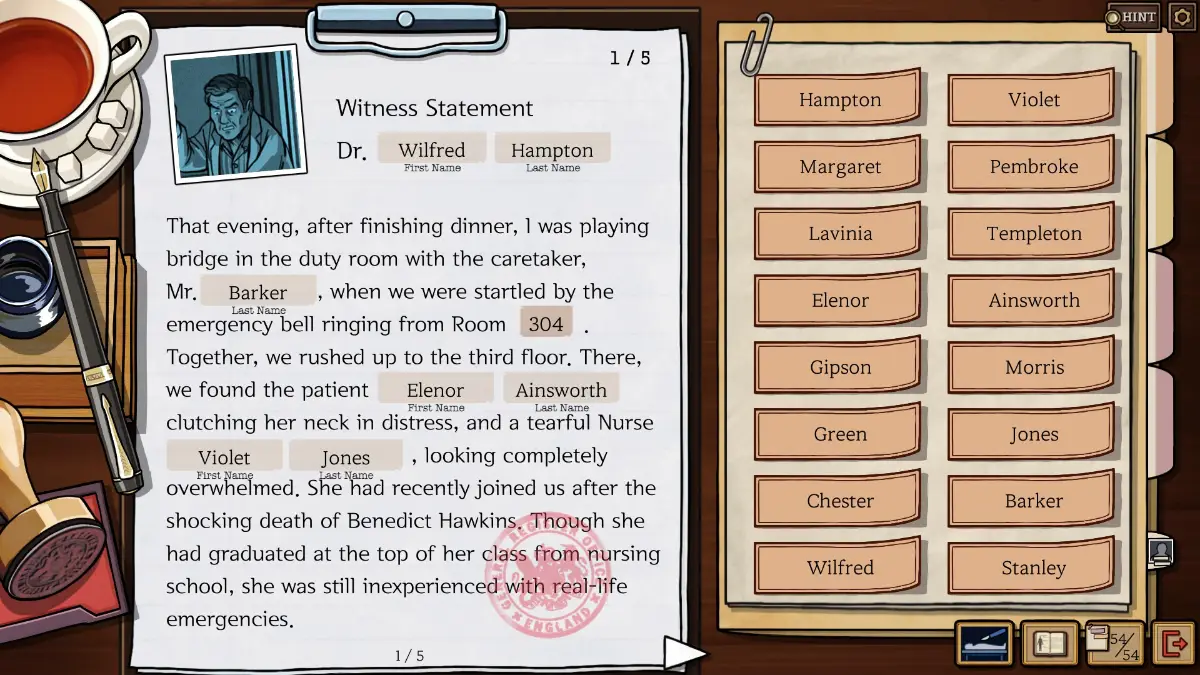
- The doctor’s statement has a few harder parts. The victim’s room number and the layout of the floor are the trickiest. Is there a map?
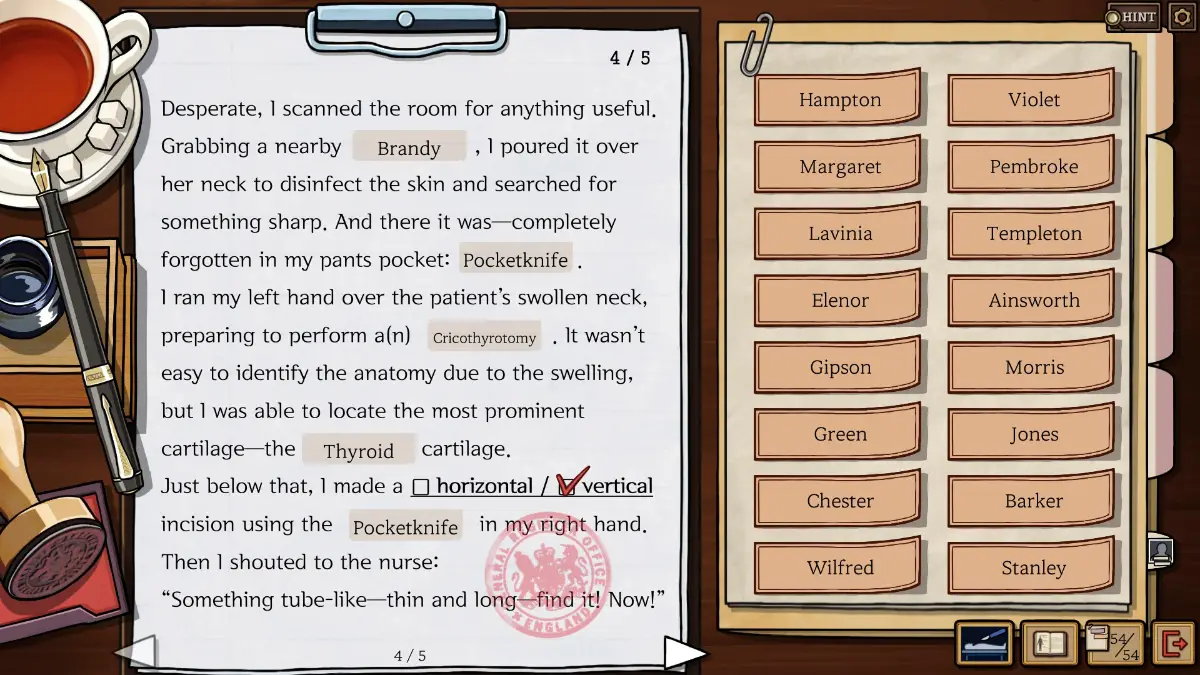
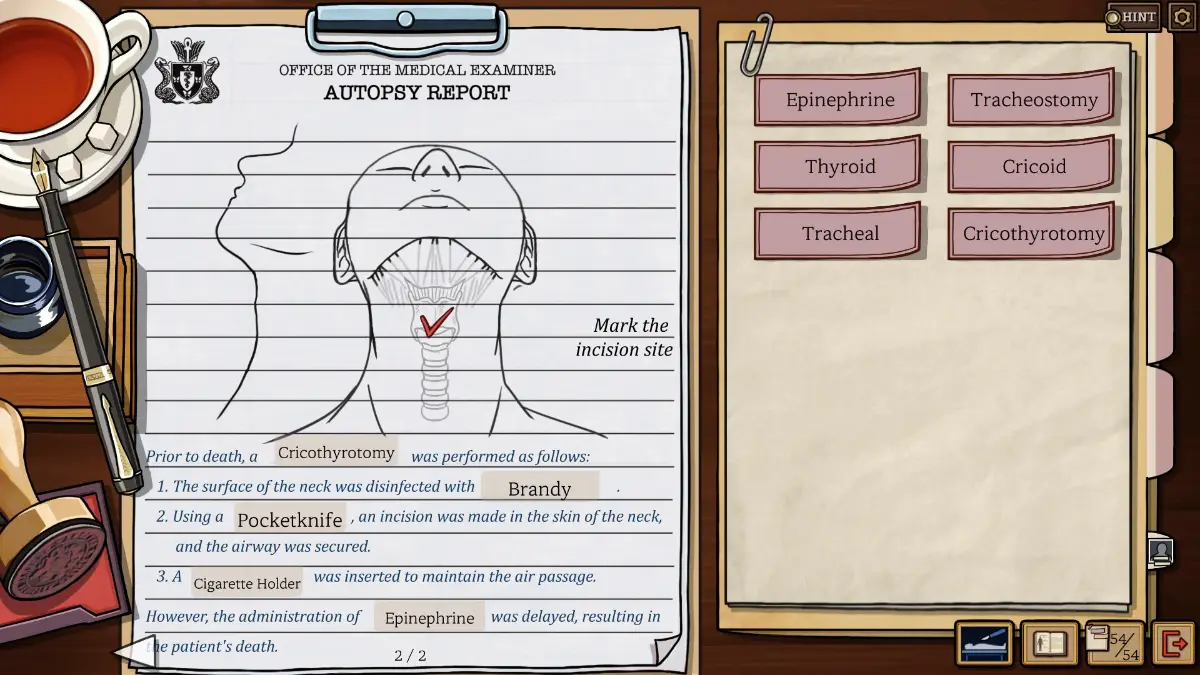
- He describes the procedure he performed step by step. Most of the answers come from the medical book and the pathologist’s findings. Several items were improvised: a sharp object from his pocket, something to disinfect with, and a tube-shaped object.
- Most disinfectants are alcohol based.
- The tube-shaped object must be blunt, or it would cut her. It also has to be long and thin, which rules out the spoons. Think of something shaped a bit like a pen or pencil.
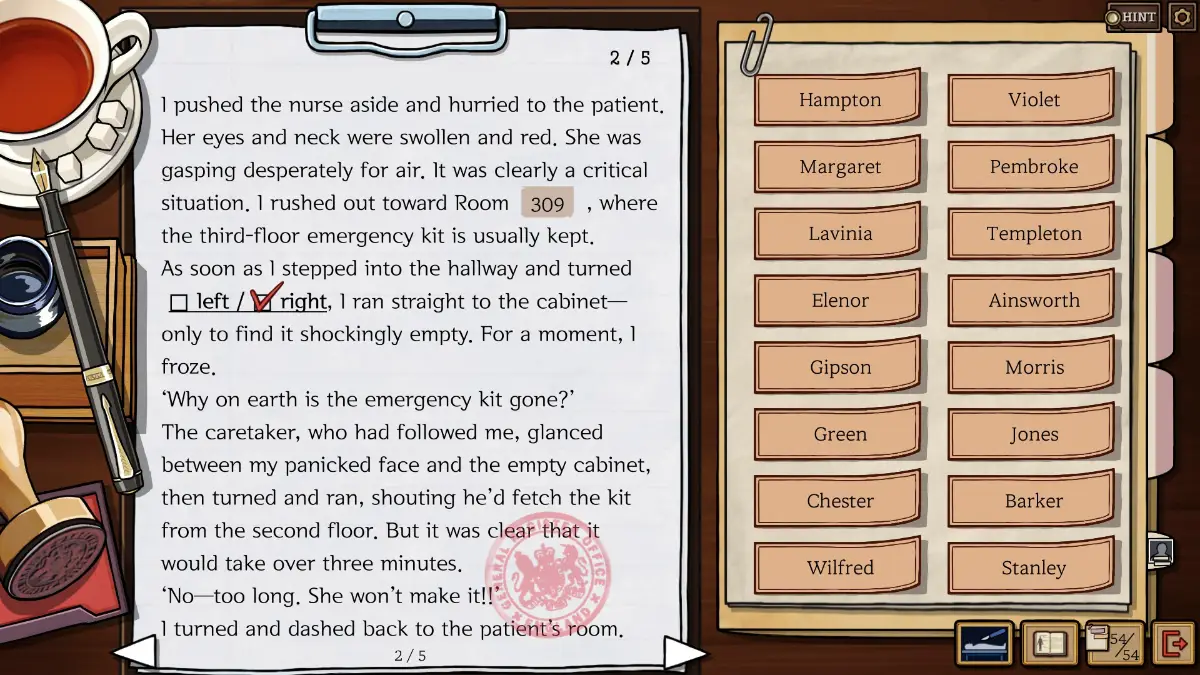
- Part of the doctor’s statement covers him going for the first aid kit. The question about which room it is in really means which room it sits outside of. The direction he turned to reach it depends on which room the victim was in.
- For the room, use the map in the hallway. It shows the fire extinguishers, the first aid kit, the stairs, the restrooms, and each room’s layout. Every room type appears twice, and the copies differ in their windows, the way the door opens, the size, and where the bed is. Only one room matches the map.
- As in Episode 1, the map does not face the same way as the room. Turn your head or the image 90 degrees and it lines up.
- If you are stuck, sketch the victim’s room on paper or in an image editor. Ignore the bed and just put the door and windows on the correct walls.
- The way the door opens matters most. The hinge is on the same side as the window, which leaves only a couple of rooms.
Doctor’s Statement
Nurse’s Statement
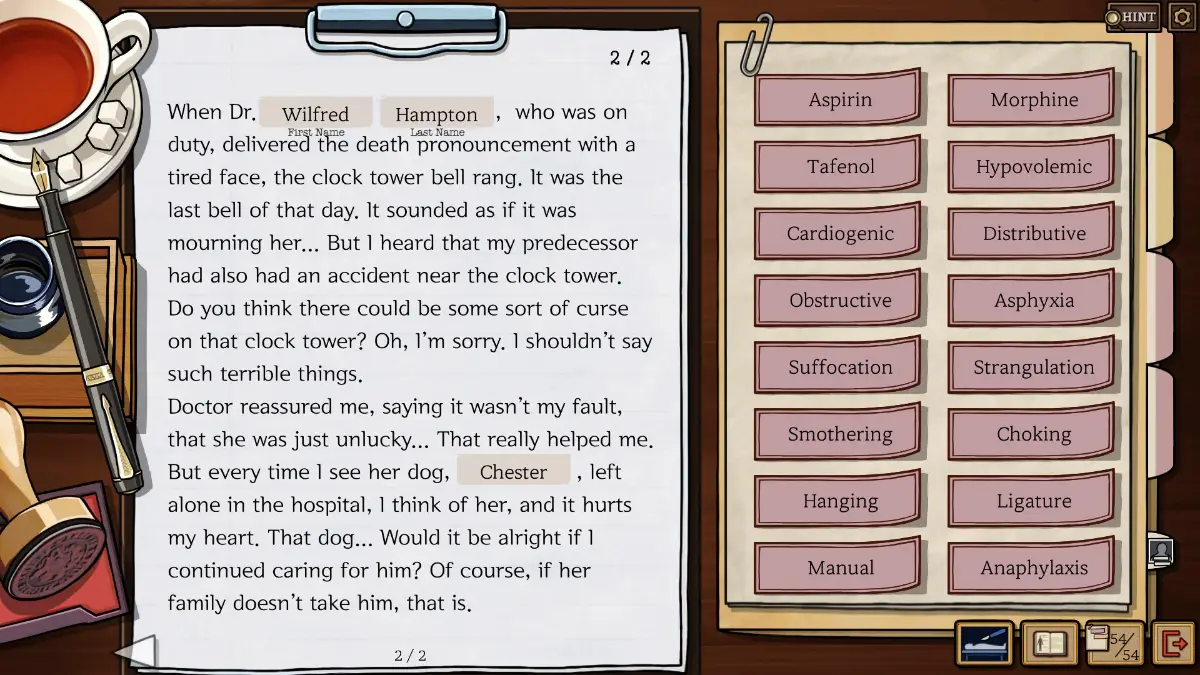
Medicine Sorting Puzzle
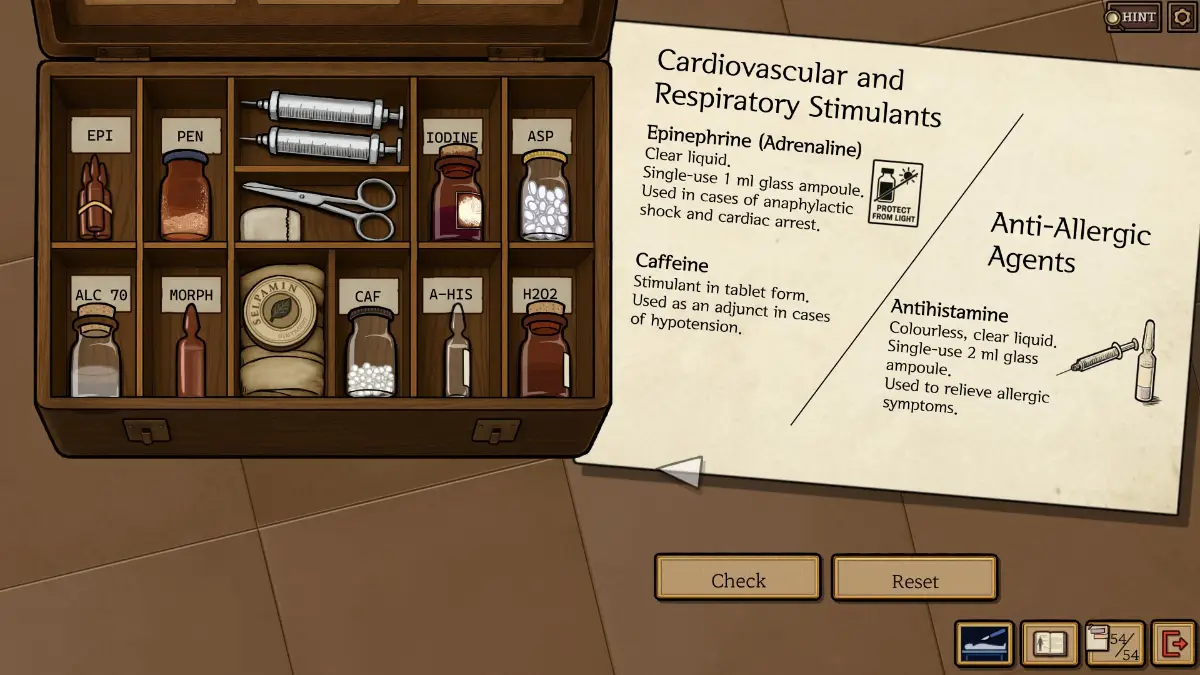
- Barker won’t give his statement until you sort the first aid kit. The rules explain how each item is stored.
- Anything sensitive to light goes in a brown bottle.
- Every antiseptic goes in a multi-use bottle.
- Penicillin is the only powder.
- Some ampoules hold 1 ml and others hold 2 ml. They have no labels, so judge by size.
- Caffeine and aspirin are both white tablets. Caffeine is 100 mg (from the newspaper) and aspirin is 300 mg, so the aspirin tablets are much bigger.
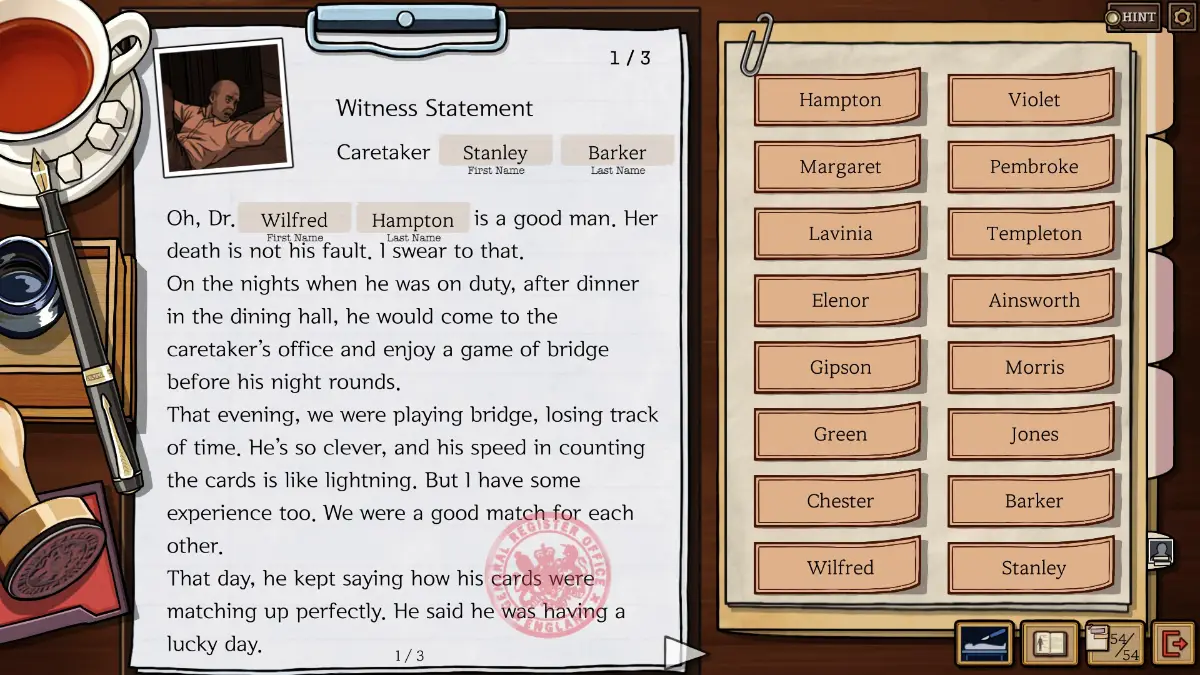
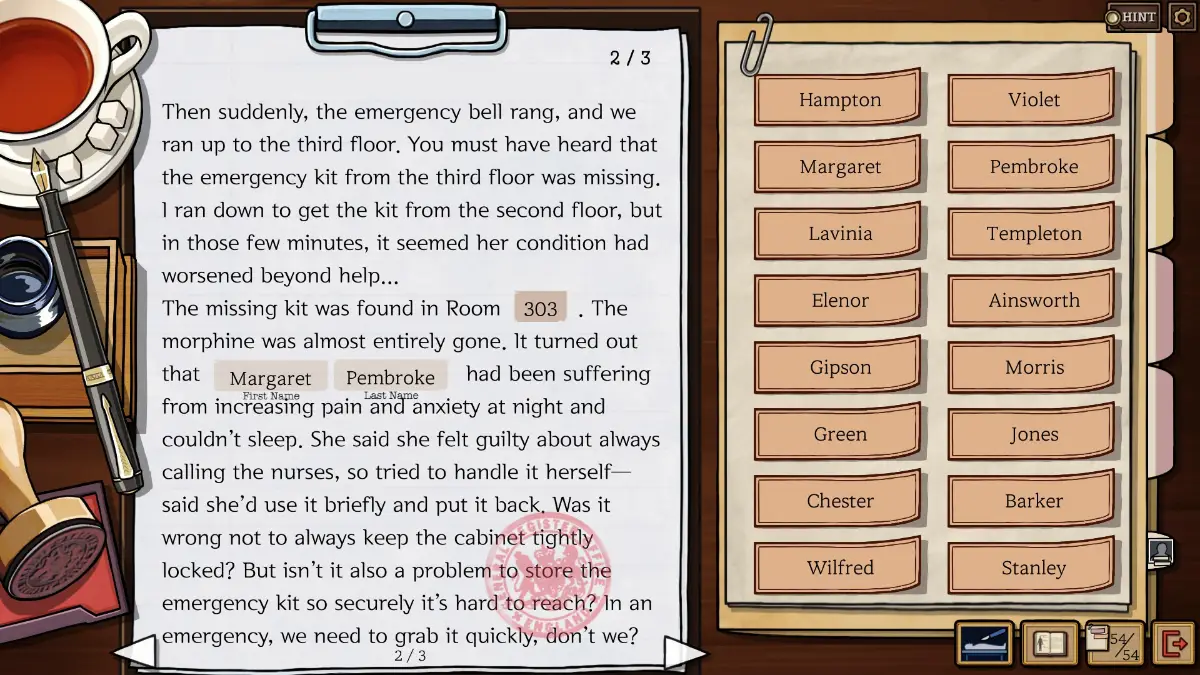
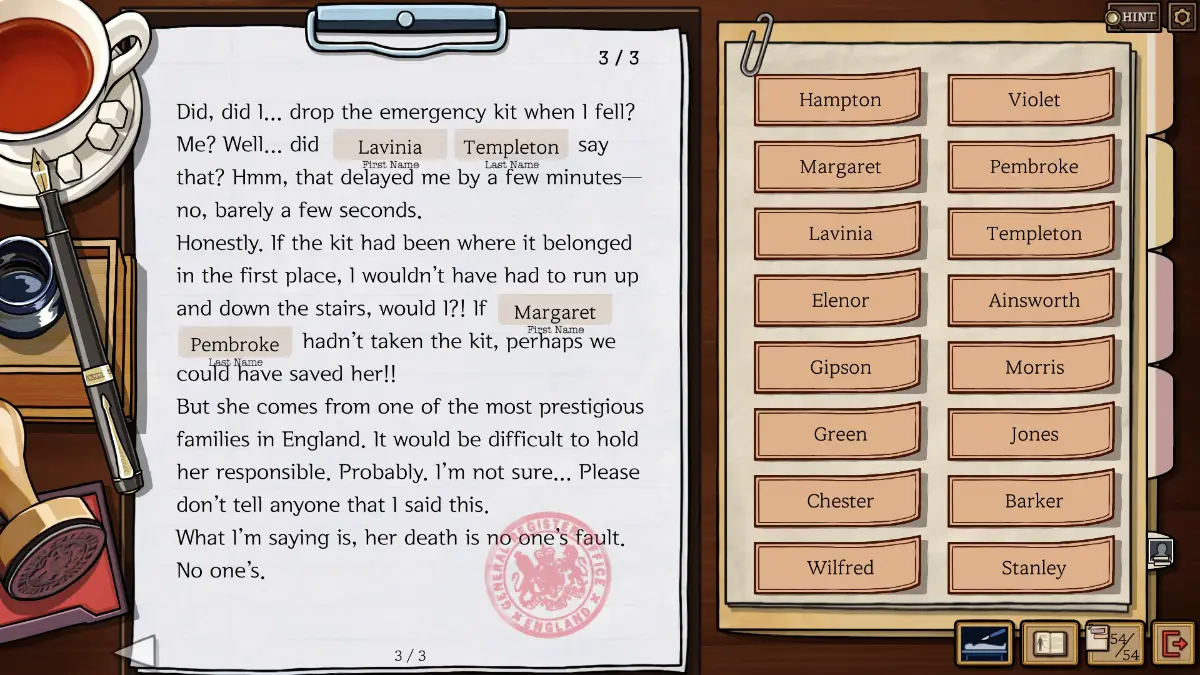
Caretaker’s Statement
- This gives you the background for the second flashback: the patient with the cat saw him drop the kit.
- You may have noticed a few loose ends: the other patients mentioned in the survival guide. A lady with a cat watched him fall, and an anxious woman who kept bothering the nurses took the kit and hid it in her room.
- The anxious patient who couldn’t sleep had a room next to a specific place, and only one room fits that description.
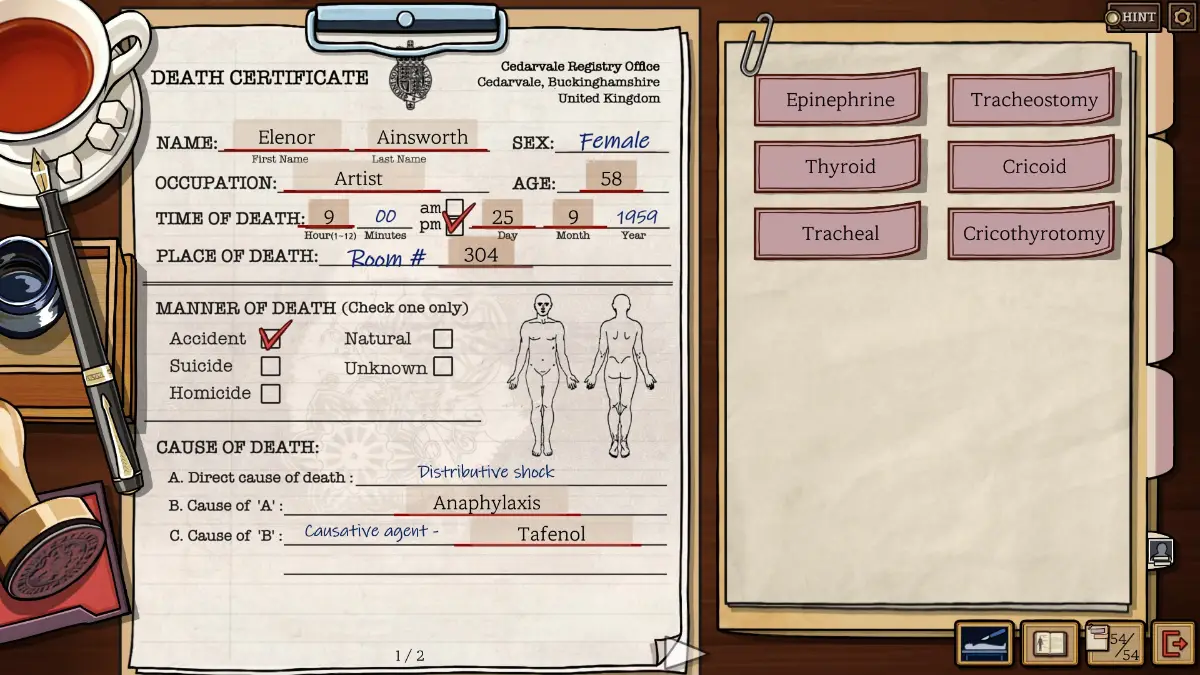
Death Certificate
- The first page covers her details and cause of death. The second covers the emergency procedure, and you already answered most of it in the doctor’s statement. Remember to mark where the incision was made.
- She had an allergic reaction. Pets can be ruled out, since she owns a dog and went to a pet event. Food is unlikely too, because a nursing home would not serve known allergens. Did she start taking anything new?
- A fatal allergic reaction counts as an accident rather than natural causes. In practice, something poisoned her without anyone knowing.
- The nursing notes stop where the death interrupted them. The nurse’s statement fills in the rest. Apart from that, the notes are detailed and clearly dated.
- The witnesses said she died at the time of the last chime.
- You don’t have her age or birth year, but the newspaper gives the year of her first exhibition. What can you combine that with to get her age?
- The pathologist says he is allergic to shrimp. His first reaction was mild, but every reaction after that was severe. Did she have a mild reaction to something recently?
- According to the newspaper, her first exhibition was in 1927, and her autobiography says she was 26 then. What year did she die?
Previous: Episode 3. Next: Episode 5. Every episode is listed in the Death at Fleming Manor walkthrough.