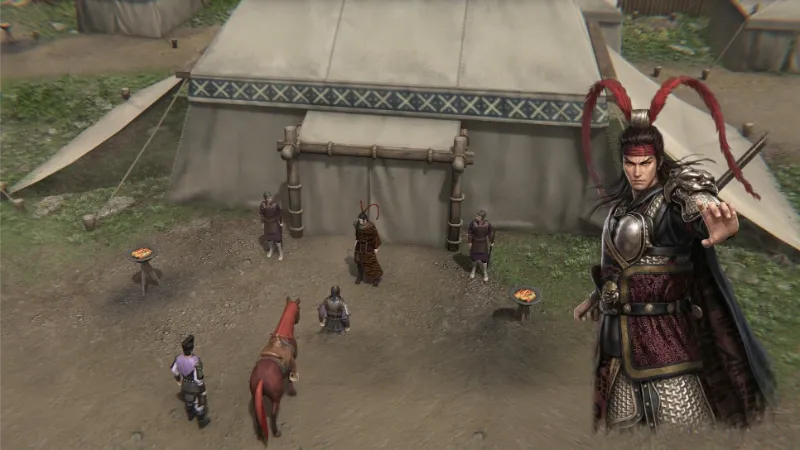
Get your first officer off to a solid start in Heroes’ Vow: Three Kingdoms with practical tips for new players.
Heroes’ Vow Three Kingdoms: Beginner Tips
These tips come from about 80 hours of play with an officer built for battle. They don’t cover playing as a ruler or building a character for debates.
Your avatar
Your avatar is the character you control for the whole playthrough. They never age and can’t die permanently. Whether you pick a premade character or create your own, two choices make the early game much easier.
Start with high stats
The game is hard on characters with below-average, average, or even above-average stats. Keep your combat stat at 80 or higher. That is Strength, Charisma for art weapons, or Intelligence for scholar weapons.
Keep Intelligence at 80 or more even if you don’t use a scholar weapon. Debates use it, and they come up often. Your skill in your chosen weapon should also be in the 80s.
You can raise stats during play (see Training), but starting low and training up is a very rough road. You won’t run out of room to grow: stats can go past 100, and climbing there from 80 takes a long time. Treat 80 as the minimum for a working character. You will still need training before you can take on Lu Bu without getting crushed.
Note: In battle, your avatar is pre-deployed, often in front of enemies, and you can’t move them. Low Determination and Strength mean low HP, which makes this very dangerous.
Start with a spouse or sworn sibling
A party member who travels with you helps a lot early on. Many fights only let you bring two others besides your avatar. When a mission adds a guest officer, that leaves just one slot for your own officer. There are no scaled or beginner quests, and most battles have five or more enemies. Bring a second officer and give them strong combat stats.
Asking other officers to join your family later takes a very high relationship score. Officers already in a faction will refuse, and free officers often join a faction right before you can ask. A sworn sibling pact gets around the faction problem, but it needs even more relationship points.
Don’t use mercenaries for battle. Their HP is spread across the people in the unit, so every loss lowers their HP until you replenish them at the board or replace them. A unit with 3,000 HP across 10 people that loses 3 will start the next fight with 2,100 HP. Officers recover all their HP between battles.
Stats, skills, and spirits
Highlight an attribute to see what it does. Determination has one extra use: it gives you an additional training session with another officer each season.
Each attribute also has a Talent score, which is its growth rate. Higher Talent means faster gains. Some items you can find or buy raise an attribute or its Talent directly.
Weapon proficiency
Higher proficiency lets you draw better cards in combat. With low proficiency, you mostly get basic attacks.
- Slash: Attacks hit in a cone, which matters because you are often outnumbered. Higher skill unlocks 180-degree cones and even full 360-degree attacks. This is the recommended type.
- Pierce: Long reach, but usually in a thin line, and enemies rarely line up. Higher skill draws cards with a wider line.
- Ranged: Works like pierce. Fighting from the rear means fewer attacks. Your avatar is pre-deployed at the front, so bows are a poor fit for them.
- Art: Not the hardest hitters, but they can hit in a wide circle around the user. Their buffs and debuffs also reach every ally or enemy in a large circle.
- Scholar: Mostly buffs and debuffs, usually on a single target.
- Shields: Add defense equal to your shield proficiency times a multiplier set by the shield, but lower your AP recovery. A crafted shield can remove the AP penalty (see Crafting under Money).
Skills
A skill’s background color shows what it is used for.
Blue (legion skills): Used in legion battles. They set how well the officer handles that unit type. Three points in a unit type unlock a formation the officer can use with any unit they lead. Strategy buffs the officer’s unit in general and also helps your side build points for abilities in legion battles.
Consider starting with points in every unit type. Legion battles you don’t start yourself seem to ignore which unit you’re best with and place you anywhere. The extra formations are a bonus.
Light brown (task skills): Used in city tasks. More points unlock different cards for those tasks. Raising them also gives XP to a related attribute. For example, Order gives Strength XP.
Agriculture and Fortification also feed crafting. Agriculture and Charisma make up a character’s Tailoring skill. Fortification and Determination make up their Forging skill. Crafting can produce a better version of an item.
Green (political skills): Used when a governor or ruler sets a specific task, such as sending an officer on a diplomatic mission or a scheming quest. Raising them can also raise an attribute.
Purple (personal skills): Used when traveling the world map and dealing with people. A few need explaining:
- Medicine: Affects wounded recovery in legion battles. With some Medicine, you also get a special interaction in cities that have a clinic and a wounded officer.
- Drinking: More useful than it looks. Officers sometimes try to spike your drink to steal your things, and a high Drinking score lets your avatar notice.
- Taming: At 3, you can use the tame ability on every animal. Each tamed animal brings in 1k.
Spirits
Each spirit type has a point cap tied to one stat and grows through one kind of fight.
| Spirit | Cap based on | Gained from |
|---|---|---|
| Martial | Strength | Battles |
| Mind | Intelligence | Debates |
| Command | Leadership | Legion battles |
Your spirit level is called a realm. Higher realms give more AP in battle, a larger hand, and more cards drawn.
You can also refine spirit at your home, a scenic point, or a stratagem hall. Once you hit the cap, you need a breakthrough to reach the next realm. A breakthrough means refining your spirit, and it has a percentage chance to succeed.
Spirit points and realm set how many spirits you can equip. Spirits are skills, either passive or active. Active ones are the cards you may draw in combat or debates. Every spirit has an equip cost, and active and passive spirits use separate budgets. With 7,000 Martial points, you can equip 7,000 points of active spirits and another 7,000 of passive ones.
Pick spirits with AOE. You’re outnumbered in most battles. In legion battles you may not be, but an AOE on clumped-up enemy units is always useful.
Training
Battles and debates give XP to your equipped weapon and add spirit points. These are the other ways to raise skills, spirits, and stats.
Animal encounters
Animal fights give XP and spirit points like other battles. They can also drop meat, which gives a permanent +10 HP in battles.
Books
Books raise attributes and skills passively and also give you topics. Higher-tier books pay out more XP and better topics, but some need a minimum attribute first. Reading actively at home is faster than passive reading, and reading at an academy is faster still.
Note: Unequipping a book resets that character’s progress to 0. Every 25% read gives a skill and topic payout, and finishing at 100% usually gives a big one, so let them read a little longer before taking the book away. A finished book can be read again with no downside.
Cultivate and refine
Your home and scenic areas have buttons to cultivate an attribute or refine spirit. Each one spends a few days training it. Special locations in a scenic area boost a certain attribute. After you find one, you can return to that scenic area and click the location to go straight there. Faction members also get a spirit refinement bonus in the stratagem hall.
Other officers
Officers have a “cultivate” option with several kinds of training:
- Request special training: The officer trains one of your proficiencies. The bigger the gap between your skills, the bigger the bonus. Some proficiencies also give attribute XP; Diplomacy, for example, adds Charisma and Intelligence XP. You can only request this a limited number of times per season, and Determination raises that limit (see the table below).
- Offer special training: You train the officer and get some attribute XP yourself. Teaching Order, for example, gives you Strength XP.
- Request an arms drill: The officer trains one of your weapon proficiencies. There is no limit other than social will.
- Study under an officer: Become the apprentice of an officer whose Leadership, Strength, or Intelligence is higher than your avatar’s. Once per season, you can do a session with a large XP payout. Certain items, gifted to your teacher, allow extra sessions. You may first have to beat your teacher in the area you want to study, so getting Lu Bu as a teacher is a long shot.
| Determination | Special training requests per season |
|---|---|
| 70 | 2 |
| 90 | 3 |
| Above 100 | 4 |
Apart from the teacher option, officers don’t seem to refuse when you ask for or offer training. Training also improves your relationship with them.
Topics
Some conversation topics give attribute XP. Higher-tier topics give more. A bigger stat gap between you and the other officer also raises the payout.
Items
Several items raise attributes, Talents, and spirits. You can get them from historical events and bulletin board quests, or buy them in shops such as the clinic and the emporium.
Mercenary tutors
Two mercenary types, the Tutor and the Sage, add attribute XP every day. The amount depends on the officer’s Talent and their current attribute score. Each stops helping at a certain level:
| Mercenary | Stops raising an attribute at |
|---|---|
| Tutor | 70 or higher |
| Sage | 90 |
Note: They don’t only work in your party. If you own a residence, you can station them there with officers, and they will steadily level up those officers.
Combat
Unit size
When a generic unit’s HP hits 0 and then refills, that’s because the unit is a group of people. Spearmen, archers, and similar units all work this way. A bandit shieldman, for example, is actually 30 people.
That’s why slash weapons and a second officer matter so much. Taking out 3 or more people per swing makes early fights far easier.
Mercenaries
Unlike officers, mercenary units don’t heal to full after each fight. There are more reasons to avoid them:
- Unit limits: Even with 3 officers and 2 mercenaries in your party, most battles only let you bring 2 other units besides your avatar. Bringing 3 is rare, and you can’t call in reinforcements when a unit is destroyed. Two officers recover all their HP, have many attacks and skills, and can attack several times. Mercenaries attack once per turn, mostly with basic attacks, and get weaker each fight because they don’t fully recover.
- Same as the enemy: Mercenaries are the same generic units you fight. Your spearman is no different from the enemy’s. You usually face 5 or 6 of these units with only 3 of your own. If your 3 can regularly beat them, those units aren’t worth having on your side.
Replacing mercenaries with a single sworn sibling worked better, even with one fewer unit on the field.
Legion unit types
Legion units follow a weapon triangle:
| Unit | Deals extra damage to |
|---|---|
| Cavalry | Blade |
| Blade | Spear |
| Spear | Cavalry |
Archers take extra damage when any of these three engage them in melee.
Guard mode
By default, your units chase nearby enemies. Put them in guard mode early so you can steer them yourself. Otherwise, they may rush a fort or camp the moment you stop just outside it and get shot up. They may also charge as soon as they reach a spot you picked to get around the enemy.
Solo officers
When a unit’s count drops to 0, the officer leading it stays active and can still move. Don’t underestimate a lone officer. One enemy officer, left on their own, has beaten two full units and then the officer leading them. Your own officers can still do real damage after losing their troops, too.
Leading another unit
A solo officer can walk over to a unit led by a generic corpsman and take command of it.
Money
Money is scarce at the start, and special weapons and stat boosts cost a lot.
Clearance sale
The first time you enter a city, and at random times after that, the market runs a clearance sale with everything 50% off. The sale ends when you leave the store. You can use this for profit:
- Buy everything during the sale.
- Leave the store.
- Go right back in and sell it all back.
Even with 0 Commerce, your sale percentage should be around 70%.
Important: A sale also halves what you earn from selling. End the sale before you sell weapons or animal loot.
Animal hunting
| Source | Value |
|---|---|
| Taming an animal | 1,000 |
| Animal bone (drops from every fight) | A little over 700 |
| Hide (some animals) | 700 |
| Tiger drop | Several thousand |
Hunting is a good way to build seed money for trading, but waiting for tame attempts to succeed gets tedious. Eventually, use auto resolve to collect bones and other loot.
Trading
Trading starts slow but can pay very well. Even if you skip it, aim for the first rank of commercial mastery so you can build a trade house.
Every city seems to have the same supply and demand, with only single-digit percentage differences. This route works well as a loop each season:
- Buy porcelain and cloth in Xiaopei.
- Buy tea in Xiapi.
- Sell cloth in Qiao and buy tea.
- Buy porcelain in Xuchang.
- Sell tea in Luoyang and buy porcelain.
- Sell porcelain in Chang’an and buy jade.
- Sell jade in Luoyang and buy stationery.
- Sell stationery in Xiaopei.
A city’s stock size and variety are said to depend on its commerce and agriculture scores. In practice, trading more in a city seems to make it carry more stock later.
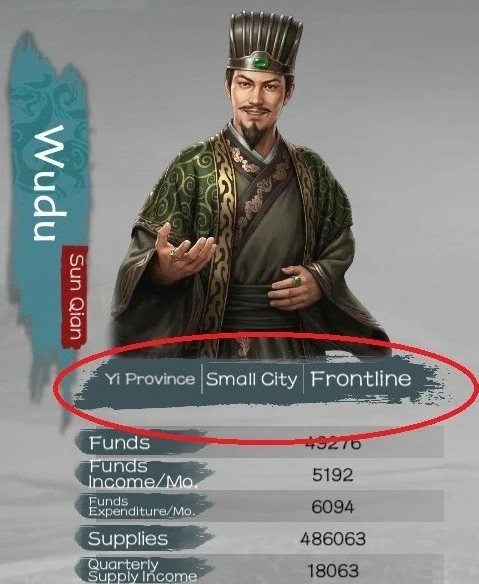
A messenger sometimes reports rising prices in other areas, but names a region such as “Yu Province” or “The Frontier” instead of a city. To find a city’s region, open its city info. The province and designation appear under the governor’s portrait.
Trading house
A trading house earns a lot. Beyond the setup cost, the only upkeep seems to be the officer you assign, who costs nothing if they’re a sworn sibling. Getting the 1k commerce is well worth it even if you don’t trade, and the third tier, which adds another house, is arguably worth it too. These raise its income:
- Wagons: Without wagons, the house won’t work. Hire them at the bulletin board. Income is based on the house’s cargo capacity. The best option is the deluxe wagon convoy, at 12k each.
- The officer’s commerce skill: Hire anyone with 3 or more commerce as soon as you find them. You can also have a party member carry a commerce book, or learn commerce with your avatar and give your future merchant special training each season.
- Location: Cities with a high commerce score pay more. Build in Luoyang or Chang’an, which usually have over 10k commerce.
- Market share: Income also depends on how much property you own in the city. Buying extra land for more markets raises it further.
Private estate
You can buy property in cities and build on it. Marketplaces come first, and later you can research casinos for a higher payout. How much land you can buy depends on your relationship with the ruling lord or governor. Introducing yourself to the lord doubles that amount with little effort. If you don’t want to bribe the government guards to reach them, do a domestic bulletin quest for them instead.
Check a city’s civil tax rate before you buy land and fill it with markets. Tax cuts your income: a market earns 100, so in a city with a 70% tax rate it brings in only 30 a month.
Some commerce buildings raise the income of others. Markets placed next to a tavern or pond earn more, and one tavern can boost several markets. It’s unclear whether the tavern has to be yours or if an NPC-owned one works. If you have the money and land, plan where each building goes.
The small villages outside each city also have property you can buy for markets.
Salary
Joining a faction pays 1,000 a month right away as title income. Higher titles pay more; at third rank, it’s 2.5k a month. You also get a separate salary on top of that.
Mercenary contracts
You can arrange mercenary contracts with several factions. Expect to be rejected or asked to win a debate first. Being good friends with the ruler skips this, but befriending a ruler is slow because of their relationship point penalties.
A contract pays you for loaning out your private troops. The faction can also “rent” your family and retainers, which earns you more. A governance mastery adds extra income from this.
Crafting
Crafting isn’t the best way to make money, because you depend on shops having the materials in stock. Rarer items usually appear once per season, and even excellent items may have only 3 to 5 in stock.
If you can gather materials and have a good Forging or Tailoring score, crafted gear is worth more than its materials and more than the item’s normal price. A simple Longsword, for example, takes 800 in materials bought at 100% value and is normally worth 1k. An officer with 90 Determination and 3 Construction makes one at 200% quality, worth 2k.
To learn more recipes, deconstruct an item to get its blueprint.
Social
The world has many officers, so focus on one at a time. The free topics from the old man at the start can win you a good friend early. Once those major topics are used up, progress slows down a lot.
Free officers
Factions recruit free officers fast, which is the main reason to focus on one at a time. A free officer will join you at best friend status (tier 3) for a salary of 100. At tier 4, you can propose a sworn sibling oath. It removes the salary and also works on officers who belong to another faction.
Talisman of Insight
This item reveals all of an officer’s traits at once and restores 1 social will. It still works on officers whose traits you already know, so you can use it just to refill social will. That helps you reach the 3 social will needed to ask a free officer to join your family. Waiting for the next season instead can mean someone else hires them first.
Officers also seem to give you topics far more often once you know all their traits and have a deep talk with them.
Buy these from the spirit trader whenever you can.
Gifts
Gifts give relationship points and can also restore social will. Gift preferences show as traits with a blue background. A gift that matches one of those traits restores social will. Finery loving and armor loving were bugged when the source was written.
The required quality depends on the officer’s status. Most officers want good quality, but governors and rulers may want excellent or even rare. Read the dialogue when you click Gift, since it mentions the quality they expect.
Cultivation
Officers seem to always agree when you ask them to train you in a skill or weapon. Along with the training, you get the same relationship boost as a deep talk.
Banquets and feasts
You can host a banquet at the bar once per season in every city. A handful of the city’s officers attend, especially those with the wine loving trait. Those officers sometimes host banquets of their own. Either way, you gain relationship with several officers at once.
As a faction officer, you’ll sometimes be invited to a feast by the city’s governor. On New Year, officers and rulers get a feast at the governor’s house, which builds relationship with a handful of faction officers.
On the last day of the year, go back to your residence to throw a feast with your family and retainers.
Obligations
You can spend obligations to:
- Have an officer join your party for a month.
- Get weapon or skill training without using social will.
- “Seek advice” once you have 3, which teaches you a spirit skill the officer knows.
Seeking advice is the big one. Some officers have unique spirits that only they can teach, and you can get only one. Get these before those officers die. On an officer’s information screen, a main martial, command, or mind skill with a yellow background is usually unique, or at least very strong.
Most obligations come from the bulletin board. Missions are quick to finish. Domestic quests usually take a month or two, depending on your skill in the task.
As a city governor or ruler, you can assign an officer to a task you’re good at and then do their domestic task yourself.
Events and quests
Historical events
Historical events can give very good rewards, and some let you “Defy fate” for an extra reward. To see when they happen, open the quest menu and choose the historical events tab at the top. Anecdotes are smaller historical events.
When an event is ready, a “Force activate” button appears in the quest menu. It starts the event right away and moves officers and cities to their correct factions. Two things can block it: player property protection being on, or a siege on a city that needs to change hands. For a siege, the only option seems to be hoping it ends before the event does.
Rewards include spirit and stat items, martial books, and large cash payouts. Most events with a defy fate option can add an officer to your retinue. Events with legion battles are also a good source of merit.
Faction membership
Most of these events require you to belong to a faction. The very first one, for the Yellow Turbans, accepts any faction but not a free officer. To see certain events you may need to switch factions, which is a hassle. Another option is a mercenary contract with a faction plus a pact of faith. That can count you as part of several factions for event purposes.
If you do switch factions, focus on city tasks and give your avatar the kills in legion battles to earn merit fast. At rank 5 you can become a governor, and the AI usually assigns you a city quickly. After that, you no longer get assigned city tasks or have to attend the faction council every 3 months.
Quests
Bulletin board quests earn an obligation from the officer who posted them, plus friendship points and gratitude. In many combat quests you will be outnumbered, and the quest giver takes one of your deployment slots. Skip these unless another officer with good combat skills can back you up.
Commission quests accept any crafted weapon or armor of the right quality. You don’t get the materials, so these are often best skipped.
Quests from a village elder, which often have “village” in the title, usually include a stat-boosting item in the rewards. Some feature a unique animal to fight, such as a black bear king. All animals sell for the same amount, but you can keep one just for fun.
Quick tips
- Keep your avatar’s attributes in the 80s. Low attributes make the game rough.
- Don’t assume your warrior can avoid debates or leave them to a party member. Build good debate skills.
- Use a slash weapon. You’re often outnumbered, and slash weapons have better AOE.
- Keep your weapon proficiency in the 80s. Higher proficiency gives better attack cards.
- Get Taming to 3 so you can tame any animal. Animal fights give weapon XP, martial spirit points, and money from bones, skins, and tamed animals.
- There are two crafting skills: Tailoring comes from Charisma and Agriculture, and Forging from Determination and Construction.
- Crafted items are better than store-bought ones. Deconstruct an item to learn how to make it.
- Create a spouse or sworn sibling at the start.
- Domestic bulletin board quests level up a specific skill and give XP to the attribute tied to it.
- Officers gladly train your skills, which pays out more skill and attribute XP. The number of sessions per season depends on your Determination.
- Training other officers gives you attribute XP too. It’s limited only by social will and by finding officers who have it.
- Reading at an academy is faster than at home, and reading at home is faster than passive reading over time.
- Tutor mercenaries raise attributes up to 70 and Sage mercenaries up to 90. They also train officers in a house where they’re stationed.
- Exploit the market clearance sale: buy everything, leave, then step right back in and sell it all back. A sale always happens on your first visit to a city and randomly after that.
- High civil tax in a city cuts the income from businesses you own there.
- Talk to a city’s ruler or governor once to double the property you can buy there. Doing a domestic bulletin board quest for them also works.
- Trading house income grows with the city’s commerce score. Build your first one in Luoyang.
- A Talisman of Insight restores social will even if you’ve already given that officer one.
- When presenting a gift, read what your avatar says. It tells you if the officer wants a certain quality.
- Use obligations to learn the unique skills of powerful officers. If you govern their city, put them on easy tasks and then use the domestic board to earn obligations quickly.
- Recruit free officers as early as you can. There are far fewer of them later in the game.
- Do historical events for their rewards.
- Use the force activate button to start a historical event. Turn off player protection so it works.
- A mercenary with a pact of faith counts as a member of that faction for event participation.
- In a faction, earn merit until you reach fifth rank as fast as possible and get assigned a city.
- Village elder quests tend to reward stat-boosting items.
- Avoid combat mercenaries. Using them instead of an officer costs too much, and they weaken over time because their chip damage doesn’t replenish.
- Generic units in battle are several people in one unit. The number next to the health bar shows how many people it has.
- In legion battles, cavalry beat blade, blade beats spear, and spear beats cavalry.
- All three of those unit types deal extra damage to archers.
- An officer whose unit is wiped out can still do a lot of damage alone.
- A solo officer can take command of another unit led by a generic by walking into it.